It is free and will stay free, with no ads and no accounts.
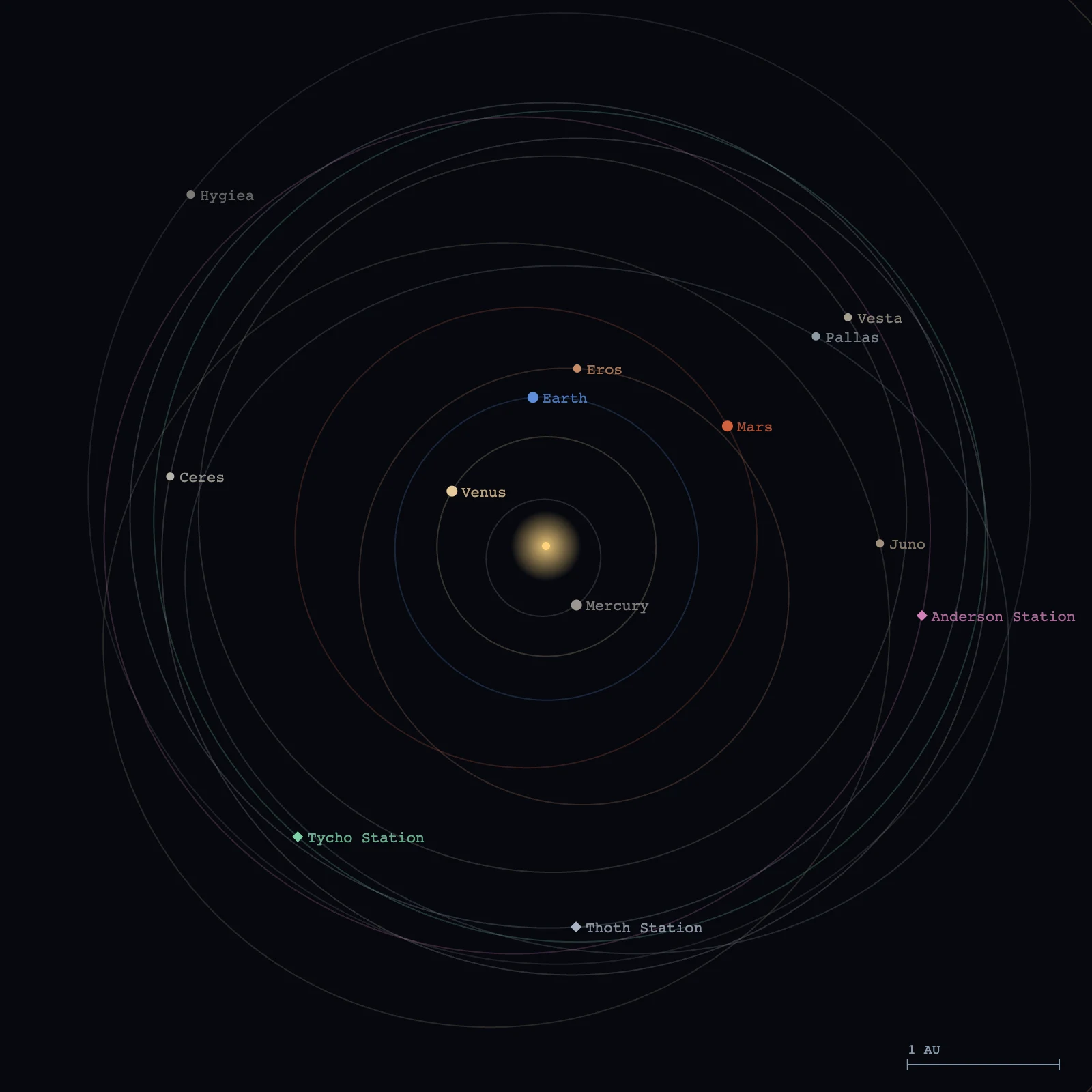
The inner planets and the Belt on 1 January 2350. The bar in the corner is 1 AU, the average
distance from Earth to the Sun.
What is on the map
The map has the Sun, 8 planets, 9 moons and 6 asteroids. It also has 3 stations from the
books: Tycho Station, Anderson Station and Thoth Station.
The planet positions come from astronomy-engine, and the asteroid positions from NASA JPL
Horizons data. The books give the stations no orbits, so the map puts all 3 on the orbit of
Ceres.
To scale
The distances on the map are to scale. Neptune is 30 times as far from the Sun as Earth.
Zoomed out to Neptune, everything from Mercury to the Belt fits in a small circle around the
Sun. Scroll to zoom and drag to move the map.
The dots on the flat map are not to scale. At the scale of the orbits, even Jupiter would be
smaller than a pixel.
The closest and farthest each place gets from the Sun, and how long one orbit takes in Earth
days and years. 1 AU is about 150 million km.
Place
From the Sun
One orbit
Mercury
0.31 to 0.47 AU
88 days
Venus
0.72 to 0.73 AU
225 days
Earth
0.98 to 1.02 AU
365 days
Eros
1.13 to 1.78 AU
643 days
Mars
1.38 to 1.67 AU
687 days
Vesta
2.15 to 2.57 AU
3.6 years
Juno
1.99 to 3.35 AU
4.4 years
Ceres
2.55 to 2.99 AU
4.6 years
Pallas
2.13 to 3.41 AU
4.6 years
Hygiea
2.81 to 3.49 AU
5.6 years
Jupiter
4.95 to 5.46 AU
11.9 years
Saturn
9.07 to 10.1 AU
29.4 years
Uranus
18.3 to 20.1 AU
84 years
Neptune
29.9 to 30.5 AU
165 years
Places on the map
The book notes below are from book 1, Leviathan Wakes. This page has nothing past book 1.
The inner planets
Mercury
Mercury is 38% as wide as Earth, and 100 kg weighs 38 kg there. A day on Mercury lasts 176
Earth days, from sunrise to sunrise.
Venus
Venus is 95% as wide as Earth. It spins backward, so the Sun rises in the west. In book 1,
Tycho Manufacturing was meant to build floating cities above Venus. The development rights
have been stuck in lawsuits for more than 70 years.
Earth and Luna
More than 30 billion people live on Earth in book 1. Luna is 27% as wide as Earth, and 100
kg weighs 17 kg there.
Mars, Phobos and Deimos
Mars is 53% as wide as Earth, and 100 kg weighs 38 kg there, the same as on Mercury. In book
1 the Martians are terraforming the planet. Phobos is 26 km long and Deimos is 16 km long.
At 100 km/h, a drive across Deimos would take 9 minutes.
The Belt
Ceres
Ceres is the largest body in the Belt, 939 km across. On the real Ceres, 100 kg weighs 2.9
kg. In book 1 Ceres is spun up to 0.3 g, which took Tycho Manufacturing half a generation.
More than 6 million people live in its tunnels. Ships bring it water from
Saturn's rings and food from the greenhouses on Ganymede and Europa.
Eros
Eros is 34 km long and 11 km wide, and its orbit crosses the orbit of Mars. NASA's NEAR
Shoemaker landed on Eros in 2001, the first probe to land on an asteroid. In book 1, 1.5
million people live on Eros. Its docking fees are low, and crews go there for the casinos.
Vesta, Pallas, Hygiea and Juno
Vesta is 523 km across, Pallas 513 km, Hygiea 433 km and Juno 254 km. In book 1, Pallas has
refineries that the Martian economy depends on.
Tycho Station
Tycho Station is the Belt headquarters of Tycho Manufacturing and Engineering Concern. It is
a ring station built around a sphere half a kilometer across. Its own fusion drive makes it
the largest mobile construction platform in the solar system. In book 1 the Nauvoo, a
generation ship, is being built there.
Anderson Station
Anderson Station is a small depot for water and air, on the far side of the Belt from Ceres.
On the map it is abandoned, after the massacre there years before book 1.
Thoth Station
Thoth Station comes into the story in the second half of book 1. The books give no location
for it, so its place on the map is our guess.
The outer planets
Jupiter, Io, Europa, Ganymede and Callisto
Jupiter is 11 times as wide as Earth. NASA counts 115 moons, and the map has the 4 largest.
Ganymede, 5,262 km across, is the largest moon in the solar system. In book 1, 45 million
people live on the moons of Jupiter. Ganymede and Europa grow food in greenhouses lit by
mirrors. Power cells come from Io, and Callisto has a shipyard.
Saturn, Titan and Phoebe
NASA counts 293 moons of Saturn, and the map has 2 of them, Titan and Phoebe. In book 1,
just under 20 million people live on Saturn's moons. Ice haulers such as the Canterbury
carry ice from Saturn's rings to Ceres. Phoebe, 213 km across, goes around Saturn backward.
In book 1 Phoebe has a science station, and Belters are not allowed to orbit it.
Uranus and Neptune
Uranus spins on its side. In book 1, about 5,000 people live on one of its moons, the
farthest settlement in the solar system. Sunlight takes about 4 hours to reach Neptune.
Fact cards
The fact card gives the size, the gravity and the length of a day and a year, with everyday
comparisons such as what 100 kg weighs there. It also gives the distance from the Sun and the
light time from Earth on the date on the clock.
The numbers come from NASA's fact sheets and JPL, and the card links its sources. Under the
facts, the card lists the events and stories from the books at that place, up to the last
book you have read.
Travel times
The flight planner gives the travel time between any two places on the map. The burn can be
set to 0.3 g, 1 g, 2 g or 5 g. Trips at 1 g are listed on the
Expanse simulator page.