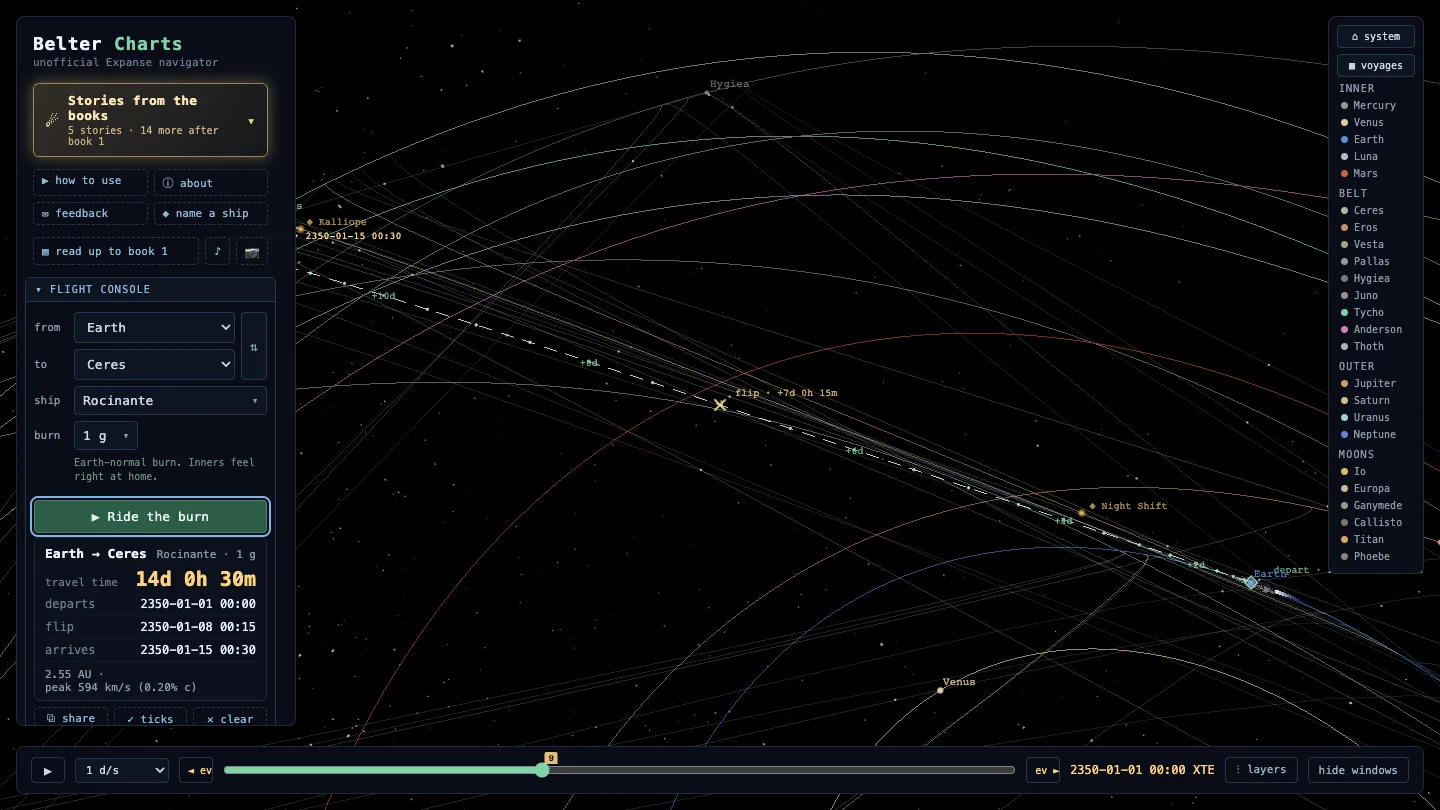
Belter Charts simulates the solar system of The Expanse in 3D, in your browser. The positions of the planets, moons and asteroids come from real orbit data. Ships fly between them on flip-and-burn routes.
It is a simulator and a map. There is no combat and there are no missions.
It is free and will stay free, with no ads and no accounts.
The chart has the Sun, 8 planets, 9 moons and 6 asteroids, including Ceres, Eros and Vesta. Stations from the books, such as Tycho and Anderson, are on it too. The Expanse solar system map page lists the places, with real facts and notes from book 1.
Planet positions are computed with astronomy-engine for the date on the clock. The asteroids use NASA JPL Horizons data.
Drag the timeline to move the clock. It covers 25 years, from 2340 to 2364. Space plays and pauses. The clock runs at 3 hours, 1 day or 2 days per second.
Click a name in the list on the right of the chart. The camera flies there and a fact card opens. The numbers are from NASA's fact sheets. W A S D moves the camera freely.
Pick a start, a destination and a ship. Then press Plan flight. The ship burns for half the trip. Then it flips and brakes for the other half.
The ship menu has 9 hulls, including the Rocinante and an ice hauler. The burn can be set to 0.3 g, 1 g, 2 g or 5 g. The flight plan gives the travel time, the flip and arrival times, the distance, the peak speed and the light lag.
Ships fly at a tenth of the g you pick. At full stated g, trips come out much shorter than the books describe.
| Route | Travel time | Light lag |
|---|---|---|
| Earth to Luna | 11h 8m | 0m 01s |
| Earth to Mars | 10d 11h 16m | 10m 47s |
| Earth to Ceres | 14d 0h 30m | 20m 44s |
| Ceres to Eros | 14d 21h 35m | 23m 14s |
| Earth to Tycho Station | 16d 8h 14m | 27m 36s |
| Ceres to Ganymede | 18d 3h 16m | 33m 46s |
| Earth to Jupiter | 21d 20h 22m | 49m 43s |
| Earth to Saturn | 28d 9h 38m | 80m 08s |
The travel time depends on the date, because the planets move. Earth to Mars at 1 g takes 5d 15h 42m for a ship that leaves on 27 September 2351. It takes 14d 19h 42m for a ship that leaves on 23 August 2350, with Mars on the far side of the Sun.
Press ▶ Ride the burn to follow the ship with the camera. Halfway, the drive shuts off and the ship flips. The cockpit view is from the ship's nose.
The dots on the chart are ships. Click one and press ◎ follow to stay with it. Supporters name the gold ones.
There are 19 stories, from 8 of the 9 books. In a flight story you ride on the ship. In a watch story you watch an event. Book 1 has 5 stories, including the Canterbury's last haul and Julie's last run from Ceres in her racing pinnace.
The timeline also has 41 events from the books. Set the last book you have read. Stories and events after it are hidden.
Belter Charts runs in a desktop browser with WebGL. On a phone you get a flat map. The planner and the ships are the same.
You can send a link to a plan, a story or a named ship. Watch the how-to video on YouTube. Belter Charts also runs as a desktop wallpaper.